

In a city where everything is ten minutes away on foot, customers do not plan: they step outside, look at their phone and walk into the first place that answers them. That is why web design in Cornellà de Llobregat has less in common with a catalogue than with a shop window: it has to say what you do, where you are and when you open before the visitor looks up from the screen.

Cornellà: 92,255 people in seven square kilometres
Cornellà de Llobregat has 92,255 inhabitants in 6.99 km². According to the geographic indicators published by Idescat, that works out at 13,198.1 inhabitants per square kilometre, against 1,763.1 across the Baix Llobregat and 253.0 across Catalonia.
That figure is not a pub-quiz fact. It means whoever is looking for you is already nearby, does not need a car to reach you, and is comparing you with two other businesses on the same street corner. Nobody opens six tabs for that: they open one, decide and keep walking.
The five-second test
Open your own page on a phone, stand up and count to five. Whatever shows up in that time is your whole website, because hardly anyone scrolls further. If that first screen holds a nice slogan and little else, the visit is already gone.
The four answers that have to fit without scrolling
- What you actually do. «Integrated solutions» is not a service. «Shutter and roller-door repairs» is.
- Where you are. Street, number and neighbourhood, written out, not only on a map that takes its time to load.
- When you open. Today's hours, with bank holidays and August included.
- How to reach you right now. A call button and a WhatsApp button, thumb sized.
Four answers. With them, the visitor stays. Miss one and they move on to the next business, which is two streets away.
Want to know what it would cost you?
We reply the same day. No commitment, no sales pitch.
More people work in Cornellà than commute out of it
This one figure explains half the city. The social security affiliations published by Idescat count 45,680 jobs in contribution accounts located in Cornellà —34,310 in services, 6,020 in industry and 5,335 in construction— against 40,390 employed residents. On top of that there are 5,020 self-employed workers and 2,509 open contribution accounts.
In plain terms: every morning people who do not live here come in to work, and people who do live here head out. Your website has two different readers and it pays to recognise both.

The neighbour who walks down the street
They search in the afternoon, after the school run or on the way home from work. They want to know whether you are open now and whether you are on their route. Opening hours, the address and a tappable phone number are enough. The 8,103 single-person households out of 34,518 in the town buy differently too: small quantities, odd hours and a lot of last-minute decisions.
The one who only comes here to work
They have lunch here, run errands here and leave at six. They do not know the neighbourhood names and none of the local landmarks mean anything to them. Tell them where to park, which stop leaves them nearby and how long it takes from where they are. If you sell to companies, this is your customer outright: those 2,509 contribution accounts are full of people who need a supplier close by and look for one on their phone, at lunchtime.
The «how to find us» page almost nobody writes
Most websites settle this with an embedded map and consider it done. A map does not answer what people actually ask. A proper how to find us page takes half a screen and saves you phone calls.
- The address as text, with the number and postcode, so it can be copied and pasted.
- A visual landmark. «Above the chemist», «on the corner by the market». That is how people here give directions.
- Where to leave the car and whether there is paid street parking, which in this city settles more decisions than price.
- The nearest stop and how many minutes it is on foot.
- Which door and which buzzer, if you are in an office block or on a mezzanine.
- A photo of the front as it looks when you arrive, not at night and not retouched.
It is the section first-time visitors are most grateful for, and the one that carries the most weight when somebody searches for a service «near me» and has to pick one of three.
Opening hours, up top and in plain text
Opening hours inside an image are read neither by Google nor by your customer's phone on a weak signal. Write them out, in the header or right below it, and update them when they change. If you close for the holidays, say so on the website the same day you say it on the door.
They also have to match your Google Business Profile, because when one says one thing and the other says something else, the customer trusts the one that wasted their trip: neither.
The call button goes before the form
People reading on their feet do not fill in six fields. They call, or send a two-line WhatsApp. The form makes sense for whoever writes at eleven at night, and it goes after, not before.
Three details that change the outcome: make the phone number a real call link rather than a number typed by hand; keep the button pinned while the page scrolls; and, when the form is used, ask for three things instead of ten. Every extra field is somebody giving up.
A closed shutter shows on the website too
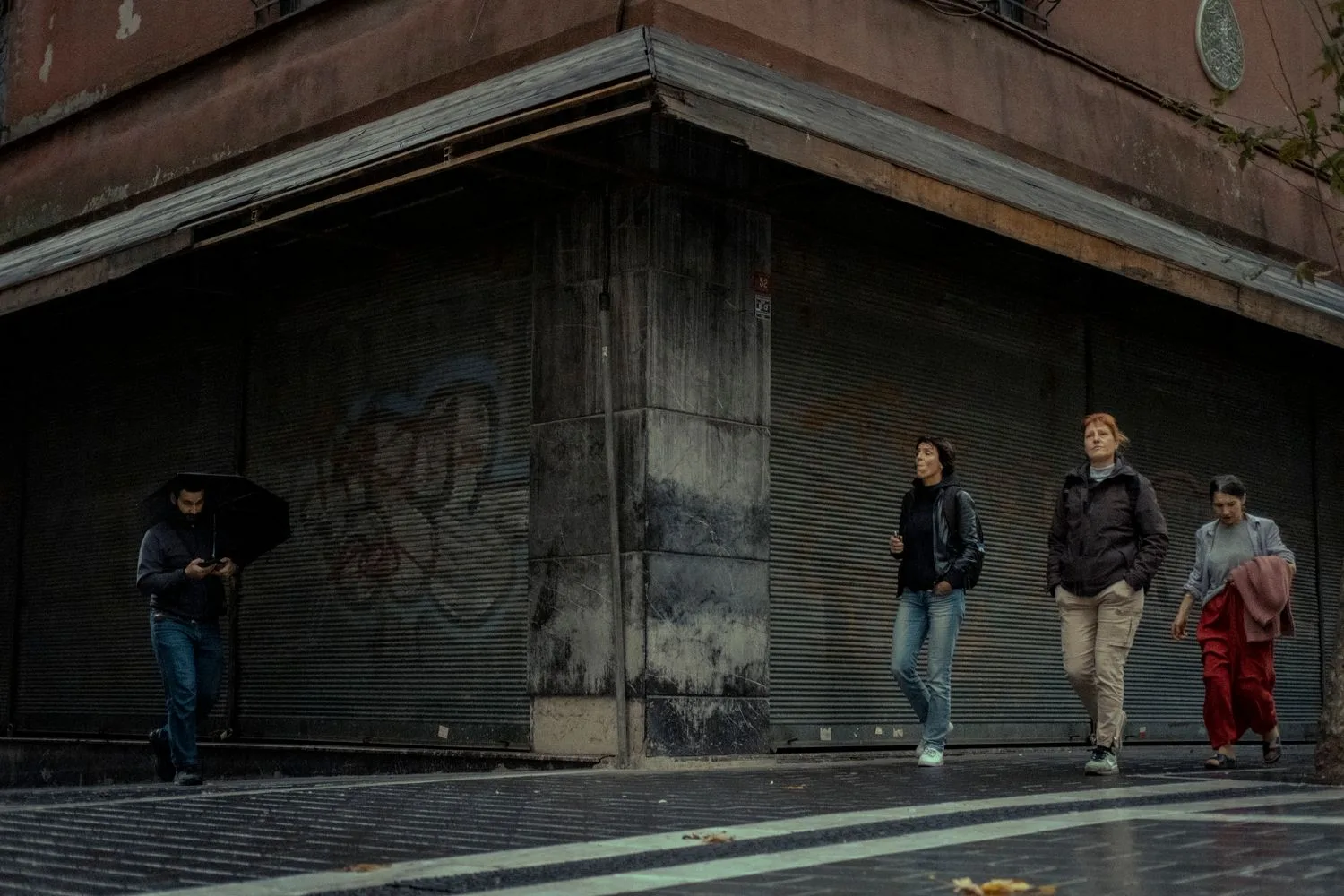
Walking past a shuttered shop on a Tuesday morning tells you something very concrete about the business. An out-of-date website does the same: the last notice is three years old, the phone number has changed and the news section is empty. You do not have to publish every week, but what is there has to be alive.
The minimum for not looking closed: correct hours, correct phone number, photos from this year and some sign of recent activity. That is enough for nobody to wonder whether you are still there.
Three businesses in Cornellà and three different websites
Not every website in the city should look alike. These are the three we are asked for most:
- A shop or street-level service. A page and a half: what you sell, where you are, opening hours, phone number and photos of the inside. The Google listing does half the work.
- A services or industrial company. Here the service catalogue rules, along with the sectors you work for, a couple of solved cases and a serious way to request a quote. With 6,020 affiliations in industry and 5,335 in construction, there are plenty of customers for whom a shop-window site is not enough.
- A professional working by appointment. The diary is what matters: what you do, how long it takes, what it costs and how to book without calling.
If you work across the whole metropolitan area, see how we approach it in web design in L'Hospitalet: the radius changes, but the underlying problem is the same.
Speed matters more when the page is read standing up
Out in the street there is no wifi and no patience. What sinks a website is rarely the server: it is three five-megabyte photos, a homepage carousel and a font that downloads before the first letter appears. The rule of thumb: the first screen should be fully visible before there is time to switch apps.
«Adapting to mobile» is not the same page squeezed narrower. MDN explains it well in its guide to responsive design: the content rearranges itself to fit the space, it does not shrink. And if you already suspect yours is slow, the full checklist is in why your website is slow on mobile.
Photos from your own street, not from a stock library
A stock photo of «the team» is spotted a mile off. In a city where customers walk past your door, real photos are worth double: the front, the counter, the people serving and the finished job. Two hours with a photographer cover the whole year.
What to do and what to avoid is in photos for your website, with the detail on sizes and formats so they do not weigh more than they should.
Copy written the way you say it at the counter
The website that works is the one written the way you talk. No «committed to excellence», no filler about «tailored solutions». If you tell a customer you swap the shutter motor in two hours and it comes with a guarantee, that is what the page should say.
One trick that always works for us: write down for a week the questions you get by phone and turn them into sections. More ideas in website copy: what to write.
Spanish, Catalan or both?
The Cornellà figures settle the argument. Out of 84,207 people aged two or over, 76,626 understand Catalan and 48,150 can speak it. And 24,997 residents were born outside Spain. In other words: almost everyone understands you in Catalan, but Spanish is the contact language for a lot of people.
For a neighbourhood business the sensible route is Spanish and Catalan, both done properly, and English only when it is genuinely needed. How to set it up without duplicating the work or confusing Google is in a website in Catalan and Spanish.
The website and the Google listing pull together
In proximity searches the first contact is almost never the website: it is the listing. But the listing convinces nobody if the link leads to a slow page with last year's opening hours. They work together or not at all.
What has to match, without exception: name, address, phone and hours. From there, photos and reviews do the rest. The guide is in your Google Business Profile and, if you would rather we ran it, there is the Google listing service. When you also have to fight for searches across the area, that is where SEO comes in.
Prices on the website: when to show them and when not to
The question comes up in every meeting. Short answer: if your price is easy to understand, publish it, because it filters out enquiries that go nowhere. If it depends on a site visit, give a range and explain what it depends on. Total silence is the one thing that does not work.
The arguments on both sides, with examples, are in should you show prices on your website.
What web design in Cornellà de Llobregat costs
Our prices are published and they are the same here as anywhere else: Tu Landing, 100 € a month for a single well-built page, and Tu Web, 200 € a month, with up to ten subpages. Plus VAT and with no lock-in.
What is included and what is not
Inside: the domain, the hosting, email on your own domain and maintenance, and the domain is registered in the client's name, not ours. Outside: advertising budgets, paid directly to Google or Meta, and professional photography if somebody has to be hired for it.
If you also want articles, a managed Google listing and campaigns, the presence plans are 400, 750 and 1,500 € a month. And if what you want is to understand the market before asking for quotes, there is the rundown in how much a website costs.
We'll tell you in a ten-minute conversation
We reply the same day. No commitment, no sales pitch.
What we would do in the first week
We do not start with the design. We start by working out what people ask you and what they buy, which is usually a shorter list than it looks.
Web design in Cornellà de Llobregat: where we start
- Half an hour with you to pin down the three services that pay the bills and the five questions you are asked most.
- A look at what exists: your current site, your Google listing and the two or three local businesses you get compared with.
- The skeleton of the first screen, with the four answers in place, approved before anything is designed.
- Photos and copy, which is what really sets the timeline.
- Launch and measurement, so a week later you can see what gets read and what does not.
With the material ready, a site this size goes live in two or three weeks. What stretches projects is almost always the photos and the copy, not the development.
We are based in Sant Antoni de Calonge and we come down to Cornellà
We work from the Palau Firal in Sant Antoni de Calonge with businesses across the provinces of Girona and Barcelona, and coming down to the Baix Llobregat is a little over an hour on the AP-7. The first meeting is in person; after that, most of it is settled by phone and email, which suits anyone who is busy serving customers.
If you want us to look at the site you already have, send us the address through the contact form or by WhatsApp and we will tell you, with no obligation, what we would fix first.
Tell us what you need and we'll give you a price
We reply the same day. No commitment, no sales pitch.