

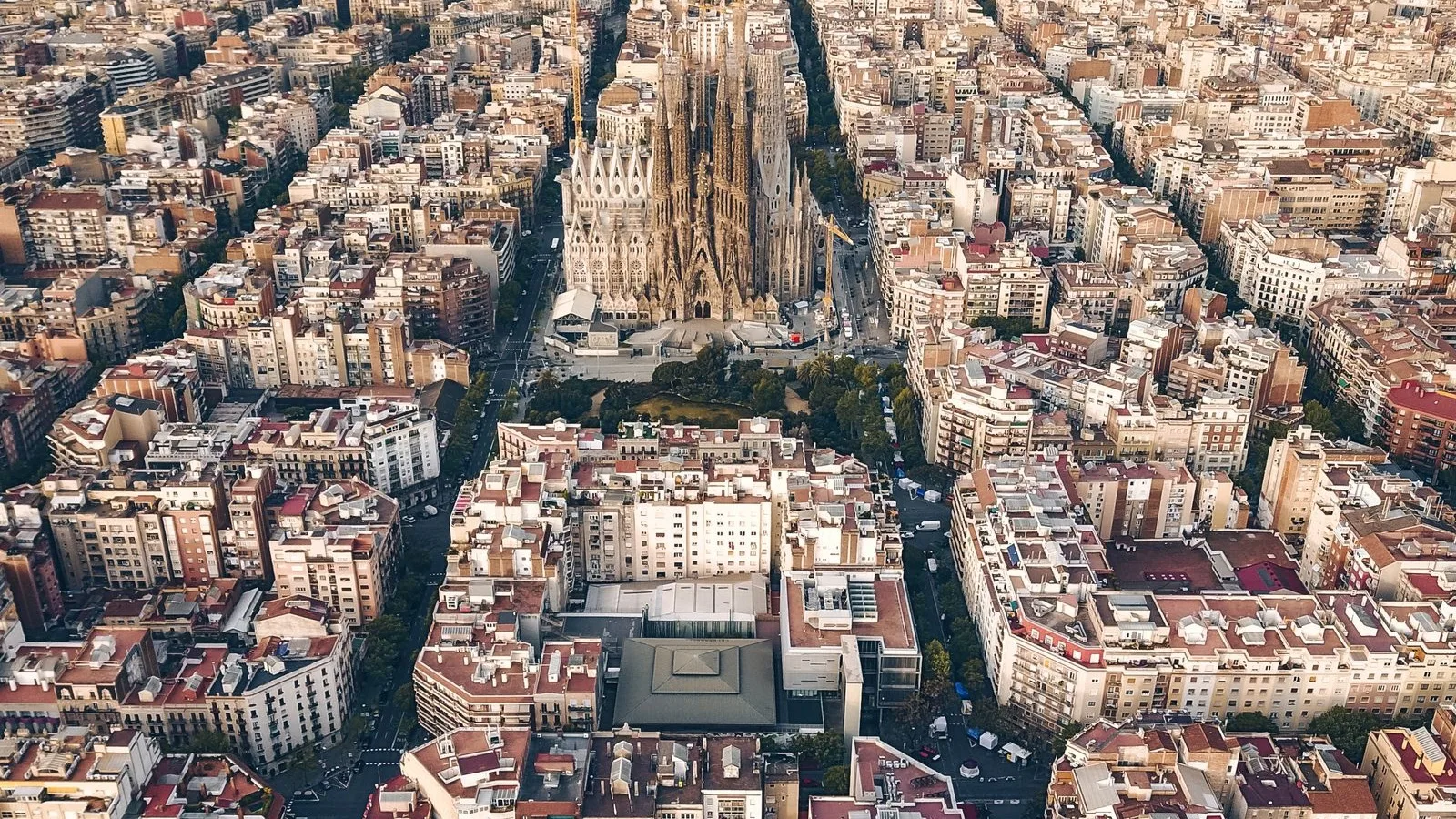
Barcelona has 1,686,208 residents in 101.35 km², according to the Idescat municipal figures: nearly 16,900 people per square kilometre. There is another number in that same file that says even more: the full-time equivalent population is 105.8 % of the resident one. In other words, more people come into the city every day than actually live in it. For your business that means plenty of demand and competition that looks nothing like a small town's. Web design in Barcelona is not about having a pretty site: it is about yours being the most specific of the two hundred that show up.
A generic website will not cut it here
In a small town you can rank on Google simply by being the only plumber around. In Barcelona that same search returns an endless list, and the person deciding does not compare twenty sites: they open three, pick the one that answers what is on their mind first and close the rest.
Winning that comparison is not a matter of size. The sites that work here are not the biggest ones, they are the most specific: they say exactly what they do, for whom, in which area and for how much. A site built to please everyone runs out of arguments precisely when one is needed.
Three different customers behind the same search
That 105.8 % of linked population is not a statistic: it is people with different schedules and needs searching for what you sell.
- The one who lives here. Searches by neighbourhood, wants proximity and usually decides on reviews and opening hours. If your site does not say whether you open on Saturdays, they move on.
- The one who works here. Lives elsewhere and searches at lunchtime or on the way home. They care about extended hours, parking nearby and whether you take walk-ins.
- The one passing through. A tourist, a conference visitor or someone in town for a medical appointment. Searches in English, does not know the neighbourhoods and decides in two minutes.
A single page cannot answer all three properly. That is why, in Barcelona, the structure of a website matters as much as the design.
The neighbourhood page, not the "Barcelona" page
This is the most expensive and most repeated mistake. A business in Gràcia creates a page called "Services in Barcelona", competes against the entire city and does not even show up on its own street. Google works with proximity and concrete signals: give it none and it treats you as one more generic result.
What an area page needs so it is not filler
A page per neighbourhood or district is only worth it if it says things only someone who works there can say: what kind of buildings there are, how long it takes to get there, where to park, which jobs you have done in the area, what is particular about the premises on that street. Three hundred words with the neighbourhood name swapped in fools nobody, and it stopped fooling Google a long time ago.
When it is not worth building
If you work across the whole city and have nothing different to say about each area, you are better off with one solid service page and a well-kept Google Business Profile, which is what distributes by proximity. Ten thin pages rank worse than one strong one, and they take ten times more upkeep.

Spanish, Catalan or English too?
In Barcelona this question carries more weight than anywhere else. The practical rule is simple: the language people write to you in is the language your website should be in. If WhatsApp messages arrive in both Catalan and Spanish, both versions pay for themselves, because they multiply the searches you can appear for without duplicating the business.
English is a separate decision and depends on your customers. For a clinic in the Eixample, a firm working with foreign companies or any business around the centre, it is the difference between entering or missing the market that tourism and new arrivals bring. For a neighbourhood workshop, it probably adds nothing.
What does not work is a half-finished translation. If you build the site in several languages they have to be marked up properly so Google shows each person the right version; Google's own documentation explains how to indicate localised versions. Done badly, you duplicate content and lose rankings instead of gaining them.
Want to know what it would cost you?
We reply the same day. No commitment, no sales pitch.
Speed gets judged on the metro
A good share of your visits will open on one bar of signal, in a carriage or waiting on a platform. If the page takes four seconds to paint the phone number, the visit is gone. Nobody forgives a slow site on mobile, least of all in a hurry.
That forces unglamorous but decisive choices: light images in a modern format, fonts that do not block rendering, no twelve-megabyte background videos and hosting that answers. It is the part of web design that never shows up in a portfolio and decides half the calls.
The four questions a converting website answers
When somebody opens your site they bring four questions with them. Answer them and they write. Fail and they go back to the results list.
- Is this for me? On the first screen, without scrolling: what you do, for whom and where. One clear sentence beats any slogan.
- Are they any good? Real work with photos, reviews, years in the trade, cases like theirs. Photos of your own premises, not stock images they have already seen on five other sites.
- How much and how soon? Indicative prices or at least ranges, realistic timescales and what is included. Silence about price does not create intrigue: it creates bounces.
- How do I talk to someone now? A tappable phone number, WhatsApp visible without scrolling and a genuinely short form. Twelve required fields are not a form, they are a toll.
Mistakes we see on websites across the city
- The gorgeous homepage that never says what you do. Full-screen imagery and one agency slogan. Five seconds later, gone.
- "We work all over Spain" from a business that serves three neighbourhoods. It dilutes the local signal and does not win the national one.
- The contact form as the only channel. In a city where everything gets settled by message, hiding WhatsApp costs customers daily.
- The site built and then abandoned. Two-year-old opening hours, old prices and a last article from 2023. Google notices, and so does your customer.
Your website, your Google listing and what AI answers
In a local search the first thing to appear is not a website: it is the map with three businesses. Your page and your Google Business Profile have to say exactly the same thing —same name, same address, same phone— or both lose strength.
And there is a third place where people already look for you: AI assistants. When someone asks a chatbot for the best place for X in Barcelona, the answer is built from what is written and organised on websites and listings. That is GEO positioning, and it runs on the same material: clear content, consistent data and pages that answer specific questions. For the classic side of it, we have our guide to SEO in Barcelona.
What a website costs in Barcelona
Our prices are published and they are the same in Barcelona as anywhere else, because the work is the same:
- Your Landing, €100 a month: one page, high-performance hosting, one mailbox on your domain and maintenance included.
- Your Website, €200 a month: up to ten subpages, two mailboxes, one article a month so the site does not stall, and maintenance.
- Digital presence, from €400 a month: all of the above plus content, Google listing, answered reviews and campaigns. Three tiers: €400, €750 and €1,500.
VAT not included, no lock-in, and website and email migration included. Custom software and automations are quoted per project, because the price depends on what has to be built. One useful warning: paying for a website in one go and letting nobody touch it for three years ends up costing more than the monthly fee, because the business changes and the site stays put.
If you are comparing quotes, in how much a website costs we break down what sits inside each line and why two similar-looking quotes may not be.
We are based in Palamós and work with Barcelona businesses
Our office is in Palamós, a little over an hour away on the AP-7. Most of the work on a website —defining the structure, writing, building, correcting— happens over video calls and WhatsApp, which is how everyone communicates anyway. We come in person when it adds something: the first meeting, seeing the premises and taking photos that do not look like a catalogue.
If you would rather have an agency with its door on your street, that is a fair preference. What we do guarantee is what usually fails: that someone picks up the phone, that a small change gets done the same day and that you always know who handles your account. If you are setting the business up right now, there are public resources and grants for city companies at Barcelona Activa.
The two-minute test before you commission anything
Take your phone, open an incognito window and search for your service plus your neighbourhood. Look at who appears on the map, who appears below it and where you stand. Then open your own site on mobile data and count the seconds until you can tap the phone number.
Those two answers already tell you whether yours is a web design problem, a search positioning one or a listing one, which are three different invoices. Message us on WhatsApp with your business name and we will tell you what we see, no strings attached and the same day.
Tell us what you need and we'll give you a price
We reply the same day. No commitment, no sales pitch.