

Two figures say a lot about custom software in Figueres. The first: of the 11,910 general-scheme social security registrations at workplaces in the town, 3,730 sit in accounts of up to nine workers and another 3,515 in accounts of ten to forty-nine, according to Idescat. The second: the town has 5,158 industrial vehicles out of a fleet of 33,129, according to the same source. Small teams and a lot of vans: the work does not happen in an office.

Figueres is a town that works on the road
Installers, repairs, maintenance, deliveries, farm services, building work. People who leave at seven, make four or five stops spread across the county and get back when the office is already shut. That day paperwork does not get done on the spot: it gets done on Friday, from memory and half-finished, and that is where the money leaks out.
The job report that never comes back
It is the scene we hear about in almost every first meeting. The technician fills in a sheet of paper, leaves it in the van, the paper gets wet or goes missing, and three weeks later someone tries to invoice the job without knowing what parts went in or how many hours it took. You cannot invoice what was never written down, and what gets invoiced late gets paid worse or argued over.
The other symptom is the phone call. Calls to ask where someone is, whether they have finished, whether they had the spare part with them. If the office does not know what is going on out there, the only tool left is the telephone.
What custom software in Figueres is and what it is not
It is not a huge system or an all-in-one management suite. It is a program built around the way you work, usually small, solving one concrete thing no off-the-shelf product does the way you need it. The general case is in when custom software pays off; this article is about the local one, which is field work.
And it does not replace your accounting or invoicing software. It sits before them, at the point where there is paper today.
The screen you use standing up
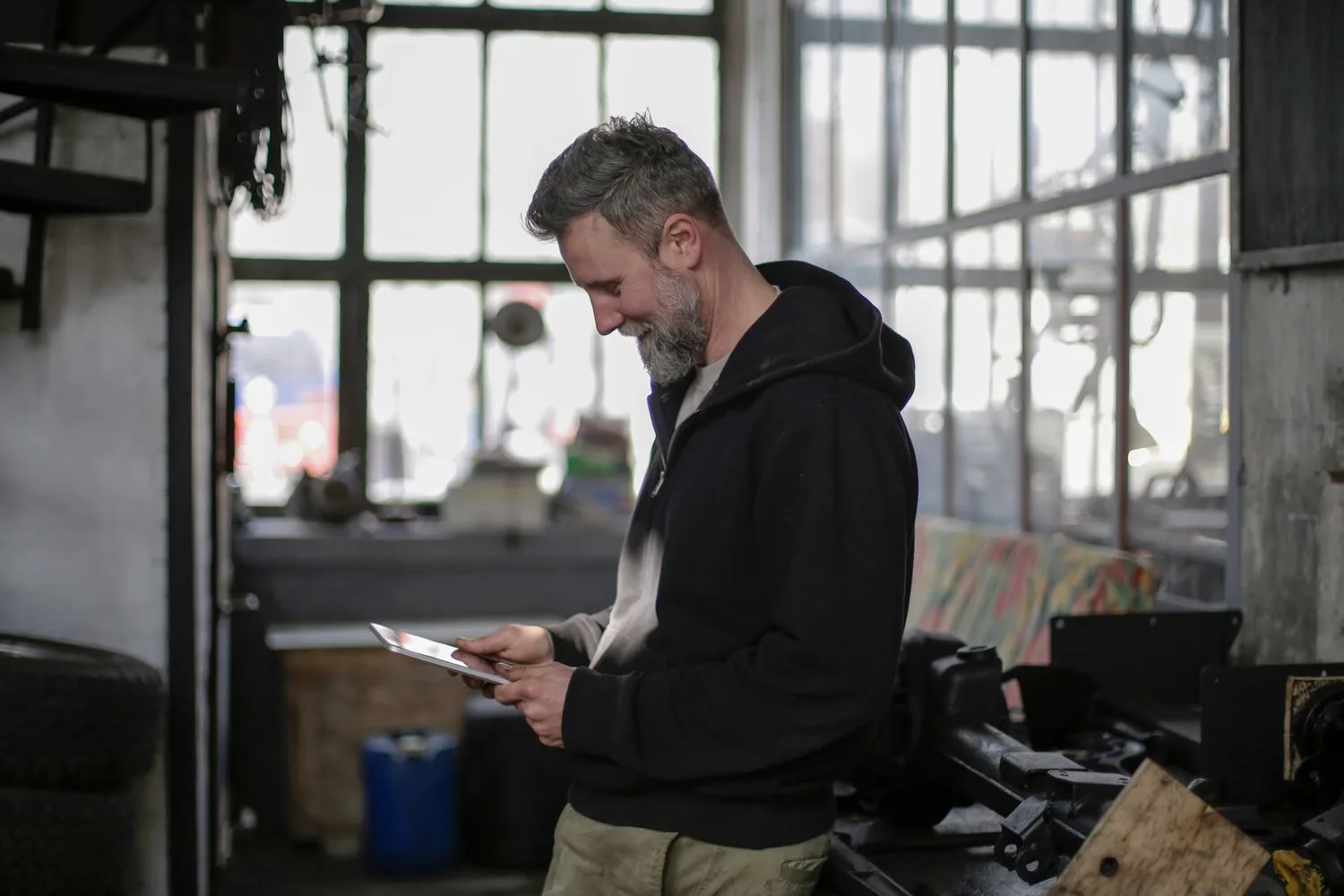
This is the difference from any office program. The person using it is up a ladder, wearing gloves, with the sun in their face and the phone in one hand. If the screen was designed for a mouse and a monitor, it will not get used: everyone goes back to paper in week two.
Four rules for a field screen
- Big buttons, few of them. The daily action, one tap away.
- No typing if choosing will do. Lists, not free text fields.
- Readable in sunlight. High contrast and genuinely large type.
- Finishable in a minute. If the report takes five, it does not get filled in.
What we build first: the report, not the system
We start with a single screen: the one replacing the paper that goes missing today. No routing, no warehouse, no invoicing. Once that screen has been used daily for a month, you find out what is really missing, and it is usually different from what everyone assumed at the start.
The five fields that cannot be missing
Customer and address, what was done, parts used, time, and a photo. That is enough to invoice without ringing anyone. Everything else is optional and usually excess, and every extra field is one more report someone leaves half done.
The photo beats the description
A before and an after, taken from the screen itself, solve three things at once: they prove what was done, they head off next month argument and they feed the quote for the next visit. And they cost nothing, because the phone is already in their pocket.
The customer signature, on the spot
Having the customer sign with a finger on the screen closes the job right there. The report leaves the village already agreed, with the time and with whoever signed it. That is what turns a visit into an invoice nobody disputes, and it is what whoever runs the admin appreciates most.
The village with no coverage
Half the county has spots with no signal, and that is the number one reason off-the-shelf field apps fail here: they come up blank. The technical answer exists and is well documented in the web.dev guides on apps that keep working offline: the screen stores the job on the phone itself and sends it when the network comes back.
What happens when the signal returns
It sends by itself, with nobody having to remember. And if the same report gets touched from two places, you have to decide beforehand which one wins: that rule is agreed at the start, not improvised. It is one of the few technical decisions worth having the non-technical people understand too.
Want to know what it would cost you?
We reply the same day. No commitment, no sales pitch.
The day sheet: who goes to which village and in what order
Once the reports come in on their own, this is almost always the next step. You do not need a route optimiser: you need each person to see their own list for the day on the phone, with the address and the number, and the office to see what is still pending without calling. The difference between that and a messaging group is that there is a record.
From report to delivery note to invoice
This is where the software pays you back. If the report carries parts, time and a signature, the delivery note builds itself and the invoice comes out of the note. What used to eat a whole Friday morning becomes reviewing and pressing a button. Where to start automating is in process automation: where to start, and what we do at each stage is on the process automation page.
What is not worth building from scratch in Figueres
- Accounting. It exists, it is cheap and it changes with the rules.
- Email and calendar. Nothing to gain.
- A basic customer file, if a standard tool is enough: we go into that in CRM for small businesses.
- The website, which is a different job at a different price: that is in web design in Figueres.
The rule we use: build only what makes you different. Buy the rest.
When custom software is needed in Figueres
Not by size, but by symptoms. If three or more of these ring a bell, you are already paying for it in hours:
- There is a spreadsheet only one person understands.
- Data gets copied by hand from one place to another every week.
- Invoices go out late because job information is missing.
- Nobody knows the status of an order without making a call.
- Every new hire has to be taught a method that was never written down.
The Monday morning test
Open up on Monday and count how many things you have to ask to know what happened on Friday. That number is the size of the problem, and it does not come down on its own.
One example from Figueres, no names
A maintenance company, six people, four vans, customers spread across the county. They invoiced once a month by reconstructing paper reports, and every month things went unbilled because there was no record of them. We built one single report screen with photo and signature, and nothing else. Two months later they were invoicing weekly and arguments with customers about what had been done had all but vanished, because there was a photo and a timestamp.
There was no system, no migration and no three-day training course. There was one screen and a new habit.
We'll tell you in a ten-minute conversation
We reply the same day. No commitment, no sales pitch.
What custom software in Figueres costs
There is no price list, and our pricing page says so: custom software, automation and the artificial intelligence work go per project, with a closed written quote before we start. A first useful screen is usually the smallest job we take on, and the full price is agreed before a line of code gets written.
Only the web and presence side has published rates: 100 € a month for a one-page landing, 200 € for a website of up to ten subpages and 400, 750 and 1,500 € for the presence plans, plus VAT and with no lock-in. If you are looking at grants, the Kit Digital has a process management category that fits this.
What to get in writing before signing
What the first version does exactly, what it does not do, the full price, who owns the code and how the data comes out the day you want to leave. If any of those five is not in writing, do not sign yet.
How long it takes and what we need from you
For a first screen, two to four weeks. We show something every week even when it is half done, because that is when the exceptions nobody mentioned turn up. From your side we need two things: one person who decides, and the team that will use it actually testing it out on the road in week one.
The data is yours and it has to be able to leave
The reports, the photos and the signatures are yours, just like your domain or your Google listing. Being able to export them in an ordinary format is not a technical detail: it is what lets you change supplier without starting from zero. Same idea as in who owns your domain.
From Sant Antoni de Calonge, half an hour from Figueres
We drive up when we need to see how you actually work, which in this kind of project cannot be done any other way, and we handle the rest remotely. Tell us what gets written on paper today and we will tell you whether you need software or just to tidy up what you already have. If what you are after is bringing in customers rather than organising the work, look at digital marketing in Figueres instead.
Tell us what you need and we'll give you a price
We reply the same day. No commitment, no sales pitch.