

When we talk about process automation in Girona hardly anyone pictures a production line. They picture an office with three desks where the work stops because a document is missing, and where somebody spends the morning chasing papers that already arrived at some point.

Girona is a city of small firms and offices
The municipality has 4,565 employer accounts, which is the closest thing there is to counting workplaces with staff on the books, and 78,980 of its 84,435 general-scheme social security registrations are in services. The figures are on the municipality in figures portal at Idescat, and they describe what you see walking through the centre: accountancy practices, clinics, law firms, architects, insurance brokers, workshops with an office attached and a lot of five-person service companies.
In places like that the bottleneck is almost never doing the work. It is gathering what you need to start: the ID, the deed, the payslip, last year invoice, the previous policy, the report.
How a document travels when there is no process
See if this sounds familiar. Paper comes in through four doors: a photo on WhatsApp to the phone of whoever took the call, an email with six attachments, an envelope somebody leaves at the counter and a memory stick. Each one ends up somewhere different, and none of those places is the case file.
Then comes the expensive part: somebody has to remember that something is missing. There is no list, there is a head. And when that person takes a day off, the file stands still.
Want to know what it would cost you?
We reply the same day. No commitment, no sales pitch.
What it costs to ask for the same paper three times
Count it in minutes and it looks cheap; count it in days and it does not. Every round is two messages, a phone call and a three-day wait, and meanwhile the file does not move. What shows most is not the time, it is the client face: for them it is the third time they have sent the same thing, and they start to think you are disorganised even if the work is flawless.
Three circuits that keep repeating here
The names change, but the skeleton is the same in nearly every job that comes to us from the city.
- Signing up a client at an accountancy practice. Identity document, working life report, bank details and the signed form. Four papers, three people and two weeks of back and forth if nobody keeps the list.
- A first appointment at a clinic. Consent form, background details and sometimes a report from another doctor. Whatever does not arrive beforehand gets filled in the waiting room, in a hurry and by hand.
- A renewal at an insurance broker. Previous policy, receipt and whatever has changed this year. If the reminder goes out late, the renewal is done in a rush on the last day.
All three are fixed the same way: a written list, one place to leave the papers and a reminder that does not depend on somebody remembering.
What we automate first in a Girona office
1. The document list for each type of file
Before anything gets programmed you have to write down which papers each kind of job needs. It is usually four or five lists, not forty. That list is the process; the rest is plumbing.
2. A link to upload, not an email with attachments
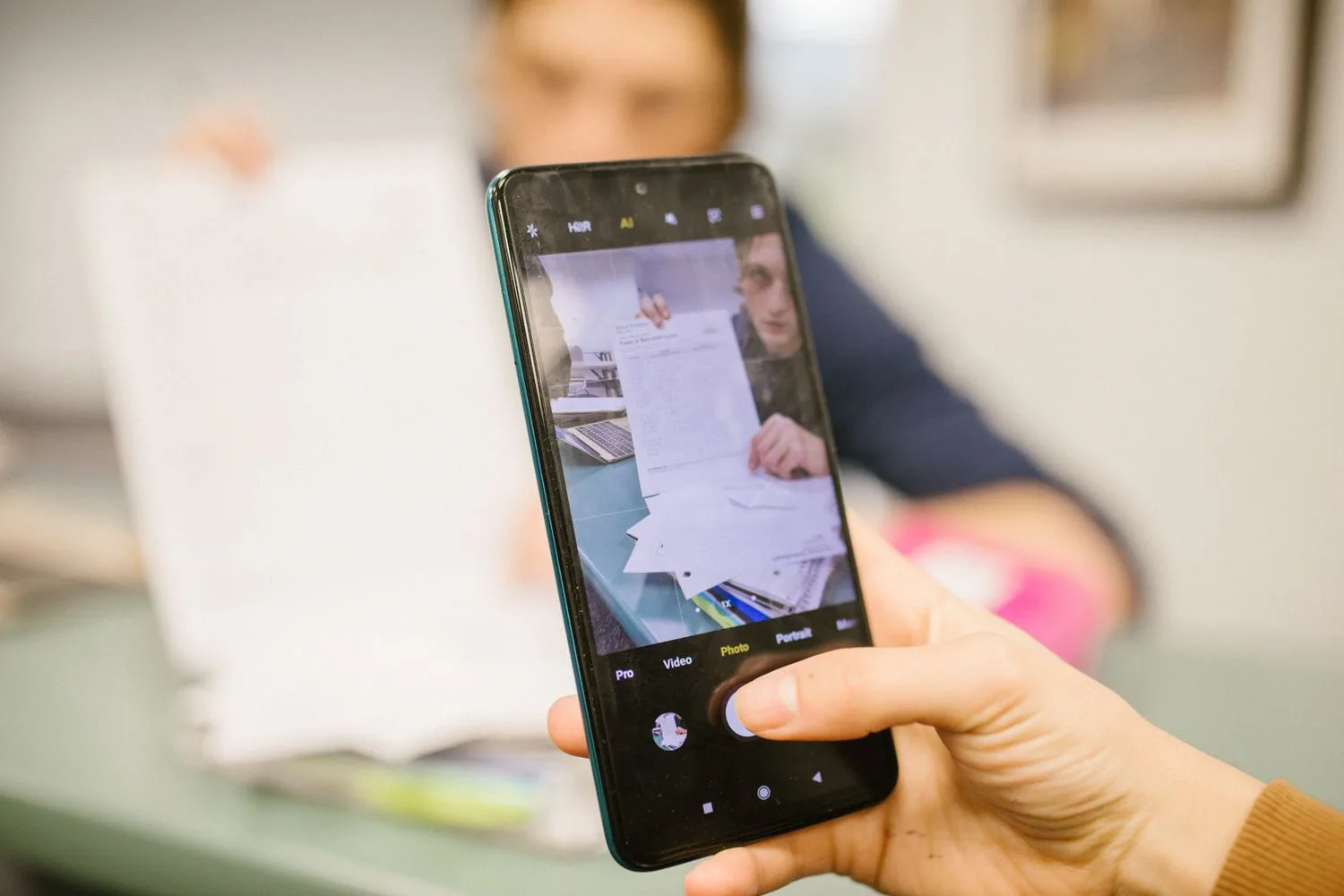
The client gets a link of their own for their file, with the list in front of them and a button to take the photo on their phone. What they upload lands straight where it belongs, not in somebody inbox.
3. The reminder no person has to send
If something is still missing after three days, a reminder goes out on its own, and another after seven. It is not nagging: it is so that nobody has to keep count. When the document arrives, the reminders stop.
4. The alert saying the file is complete
The day the last paper comes in, the file changes status and whoever handles it gets the alert. That is the starting gun for the real work, and until now it was fired by somebody memory.
The detail almost nobody builds: the file name
It sounds trivial and it is half the saving. If every document is saved automatically as file reference, document type and date, searching stops being an excavation. If it is saved as «IMG_20261012_114532.jpg», you have the same mess as before with a layer of technology on top.
What we do not automate
Checking the document, that stays human. A paper being there does not mean it is valid: the policy may have expired and the payslip may be from another month. The machine collects and files; deciding whether it is any good is work for somebody who knows. We also do not automate dealing with people who are not comfortable with a phone, which in an accountancy practice is more people than you would think. For them the old door stays open.
Papers with personal data: where they live and who gets in
What gets collected here is payslips, identity documents and sometimes medical reports, so the legal side is not an appendix. Three things we always tie down: who can open each file, how long it is kept and what happens when somebody leaves the company. The FAQ section of the Spanish data protection agency answers most day-to-day questions, and INCIBE material on document management gets straight to the point on backups and permissions.
How it gets built without stopping the office
One type of file at a time, starting with the most repeated one. Two weeks of work, one of testing with real cases, and everything else carries on as it was. If it works, the second type is added. Starting with everything at once is the fastest way to end up with two systems and neither of them finished, and we go into it in where to start.
We'll tell you in a ten-minute conversation
We reply the same day. No commitment, no sales pitch.
This is not about changing your software
Hardly anybody needs to throw out their management software. What tends to be missing is the piece in front of it: the one that collects, chases and files before the data reaches wherever you already work. When building something of your own pays off and when it does not is in custom software in Girona, and to decide which task is worth touching first there is the filter in which tasks to automate.

What process automation in Girona costs
This service does not work on a monthly fee. Our prices page says it plainly: process automation, custom software and the artificial intelligence work go by project, with a closed written quote before we start, because the price depends on what has to be built.
What does have a published rate is the web and presence side: 100 € a month for the one-page landing, 200 € for the site with up to ten pages and 400, 750 and 1,500 € for the plans that add articles, the Google listing and campaigns. All plus VAT and with no lock-in. If you are looking at grants, the Kit Digital has a process management category worth checking before you commission anything.
What to look at a month later
Three numbers, and none of them needs a dashboard: how many documents were asked for twice, how many days pass between opening a file and having it complete, and how many hours a week go into chasing papers. If the first goes down and the second gets shorter, it is working. If they do not move, the tool was not the problem.
We are in Palamós, half an hour from Girona
We work with firms and companies in the city and the comarca, and on projects like this we turn up in person on day one: you have to see which door each paper comes through and who touches it. If you want a quick read on it, tell us which type of file goes round in circles the most and we will tell you what can be taken out of the way, with no commitment.
Tell us what you need and we'll give you a price
We reply the same day. No commitment, no sales pitch.